
What Should Be On An RV Trip Checklist?
A good RV trip checklist should cover more than clothes and snacks. Before you leave home, make sure you’ve checked your travel documents, campground confirmations, towing setup, tire pressure, safety gear, water and sewer hookups, kitchen and bathroom supplies, and the small items people tend to forget like wheel chocks, power adapters, flashlights, and tank treatment.
The goal is not to create the world’s longest packing list. It’s to make sure your RV is road-ready, your campsite gear is actually in the rig, and you don’t pull out of the driveway only to realize something important is still sitting in the garage.
There’s a certain kind of optimism that shows up right before an RV trip.
The tanks are empty. The fridge is stocked. The weather looks good enough. You’ve got the route in your head, maybe a campground confirmation buried somewhere in your inbox, and there’s that moment where it all feels easy.
Then someone asks a question like, “Did you bring the water pressure regulator?”
And suddenly the whole trip feels a little less easy.
That’s the thing about RV travel. It usually isn’t one big mistake that causes trouble. It’s the small stuff. A missing power adapter. A low tire. A forgotten sewer hose cap. A dead flashlight. A campground reservation you thought you saved but didn’t. None of it sounds dramatic at home. On the road, it can turn into a headache fast.
That’s why I like having one simple RV trip checklist to run through before every trip, whether it’s a quick weekend campground stay or a longer road trip with a few stops along the way. It doesn’t need to be complicated. It just needs to help you catch the little things before they become roadside problems, late-night Walmart runs, or that sinking feeling when you realize the one thing you forgot is the one thing you actually need.
Important RV Documents And Trip Details To Double-Check
Before you worry about hoses, hookups, or whether you packed enough coffee, make sure the paperwork side of the trip is covered. It’s not the exciting part, but it’s the part that can save you a lot of stress if you get pulled over, have a breakdown, or arrive at a campground that needs proof of reservation.
Before every trip, double-check that you have:
- driver’s license
- RV registration
- proof of insurance
- roadside assistance information
- campground reservations and confirmation emails
- check-in instructions, gate codes, or campsite numbers
- emergency contacts
- pet vaccination records if you’re traveling with a dog
- offline maps or saved directions in case cell service disappears
If your trip includes multiple stops, I’d also keep a simple note on your phone with campground addresses, confirmation numbers, and expected arrival times. It doesn’t have to be fancy. It just needs to be easy to pull up when you’re tired and trying to remember whether tonight’s site is 14B or 41B.
If you want a broader reminder list before any trip, it’s worth running through a pre-travel checklist before you leave, especially if you’ve booked campgrounds, ferries, or timed park entries.
RV Setup Gear You Don’t Want To Forget

This is the section that can make or break your first hour at camp.
You can technically arrive at a campsite without half of this stuff, but you probably won’t enjoy it. The best RV trips start with the boring setup gear already packed, already tested, and already easy to find.
Here’s what I’d want on board before every trip:
- freshwater hose
- water pressure regulator
- water filter if you use one
- sewer hose
- sewer hose support if needed
- disposable gloves
- black tank treatment
- shore power cord
- surge protector
- electrical adapters for different hookup types
- leveling blocks
- wheel chocks
- extension cord rated for RV use
- basic tool kit
- flashlight or headlamp for late arrivals
If you’re newer to RV travel, this is one of the easiest places to make mistakes because the items are not glamorous and they don’t always live in the same place. A good habit is to keep all of your hookup gear stored in the same compartments every trip. That way you’re not digging through random bins looking for the one sewer fitting you swear you packed.
Kitchen, Bathroom, And Campsite Basics
This is the category that gets overlooked because it feels less urgent than hitch checks and tire pressure. But once you’re settled in, these are the things that make the trip comfortable instead of annoying.
Kitchen basics
- coffee and whatever you need to make it
- drinking water if you prefer not to use tank water for everything
- paper towels
- dish soap and sponge
- trash bags
- lighter or matches if you use a grill
- food storage containers
- can opener, utensils, and a basic cooking setup
- a few easy meals for the first night
Bathroom basics
- toiletries
- medications
- RV-safe toilet paper
- hand soap
- towels and washcloths
- shower shoes if you use campground bathhouses
- extra toilet chemicals or tank treatment if needed
Campsite basics
- camp chairs
- outdoor mat
- lantern or outdoor light
- bug spray
- sunscreen
- small broom or mat for dirt control
- awning tie-downs if you use them
- fire starter and roasting sticks if campfires are part of the plan
You don’t need to turn this into a luxury packing list, but you do want the first night to be easy. I’ve found that the first evening sets the tone for the whole trip. If you’re scrambling for a can opener, a phone charger, and the only roll of toilet paper you own, it’s not a great start.
RV Safety And Emergency Items To Keep On Board

This is the stuff you hope you never need, which is exactly why it needs to be there.
Every RV should have a small safety and emergency setup that lives in the rig, not in the house where it does you no good once you’re 80 miles away. Some of this overlaps with a regular car emergency kit, and that’s fine. RVs still break down. Tires still go flat. Batteries still die. Storms still roll in when it’s inconvenient.
RV Safety And Emergency Items To Keep On Board
If you haven’t built one yet, a dedicated car emergency kit is a smart companion piece for this article and worth linking right from this section.

Towing Checklist Before You Pull Out
I’d rather look foolish pacing around the RV for two extra minutes than realize 20 miles later that a compartment door is flapping open or the power cord is still hanging out.
The Night-Before RV Departure Checklist
I like breaking RV prep into phases because trying to do everything ten minutes before departure is how things get forgotten.
The night before, I’d handle as much of the easy stuff as possible:
- load clothes and toiletries
- stock the fridge and pantry
- charge phones, batteries, lanterns, and power banks
- fill prescriptions or pack medications
- confirm campground reservations and route
- check the weather forecast
- load camp chairs, grill gear, pet supplies, and any extras
- top off propane if needed
- make sure the freshwater hose, sewer hose, and power gear are actually in the RV
- set out anything that still needs to be loaded in the morning
This is also a good time to think about organization. If your storage bays or tow vehicle are chaos, spend ten minutes fixing that before you leave. A little organization goes a long way on RV trips, and it’s one of those things you’ll appreciate the first time you need something in the dark.
The Morning-Of RV Departure Checklist
The morning of the trip is for final checks, not full-scale packing.
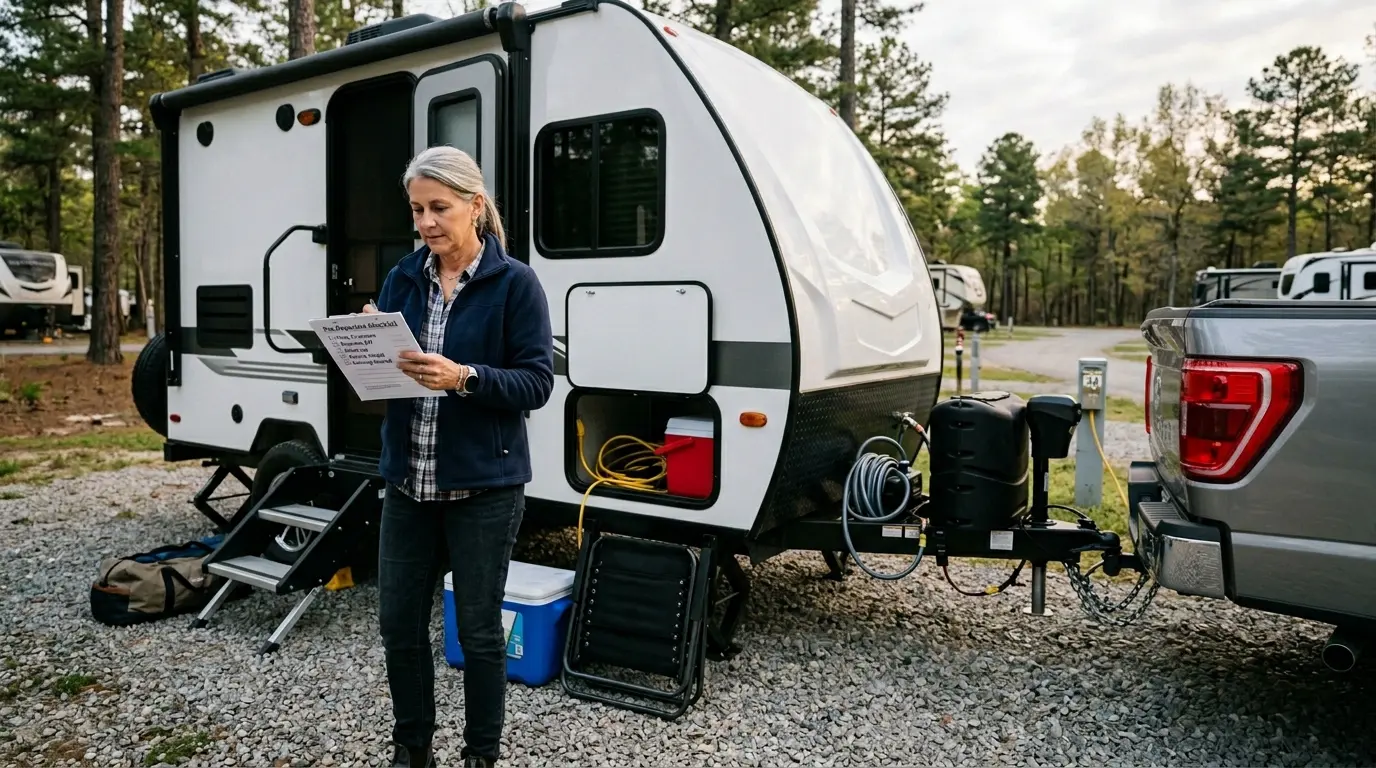
Here’s the short version of what I’d review before leaving:
- doors, windows, and compartments secured
- refrigerator latched
- loose items inside the RV put away
- water pump and tank setup checked if needed
- lights working
- tires visually checked
- hitch / coupler / chains rechecked
- steps up
- awning secured
- campsite reservation and directions easy to access
- wallets, keys, sunglasses, chargers, and coffee accounted for
Then do one last walk-around and take your time pulling out. It sounds obvious, but the most useful RV departure checklist in the world doesn’t help much if you rush through it.
Some of the most frustrating RV trip problems start with small things, not major breakdowns. A forgotten water pressure regulator, missing power adapter, dead flashlight, or overlooked wheel chock can turn a smooth arrival into an annoying scramble at the campground. That’s why a good RV trip checklist is less about packing more stuff and more about remembering the right stuff before you leave.
Common RV Items People Forget
This is the part I’d save and glance at before every trip because it’s always the same little things that seem to disappear.
Here are some of the most commonly forgotten RV items:
- water pressure regulator
- sewer hose cap
- electrical adapter
- leveling blocks
- wheel chocks
- tank treatment
- flashlight
- power cord extension
- pet leash or pet paperwork
- bug spray
- paper towels
- medications
- coffee filters or whatever weird little thing your coffee setup requires
- campground gate code or site number
- phone charger for the tow vehicle
It’s funny how often the forgotten item isn’t some major piece of equipment. It’s the one small thing that turns out to matter more than it should.
A Simple RV Trip Checklist You Can Save
A Simple RV Trip Checklist You Can Save
If you want one quick version to save on your phone, this is the one I’d use.
Final Thoughts
RV trips are supposed to feel like freedom. That’s part of the appeal. You’ve got your own bed, your own coffee, your own pace, and the ability to change the plan if you want to. But that freedom gets a lot more enjoyable when the basics are handled before you leave home.
A good RV trip checklist won’t stop every problem. You can still hit bad weather, get stuck in traffic, or discover that the campground map was drawn by someone with a personal grudge against first-time visitors. But it can help you avoid the preventable mistakes, and those are the ones worth catching.
If you make this list your own over time, even better. Add the things you always forget. Cross off the things you never use. Keep it practical. Keep it simple. The best checklist is the one you’ll actually look at before you pull out of the driveway.