

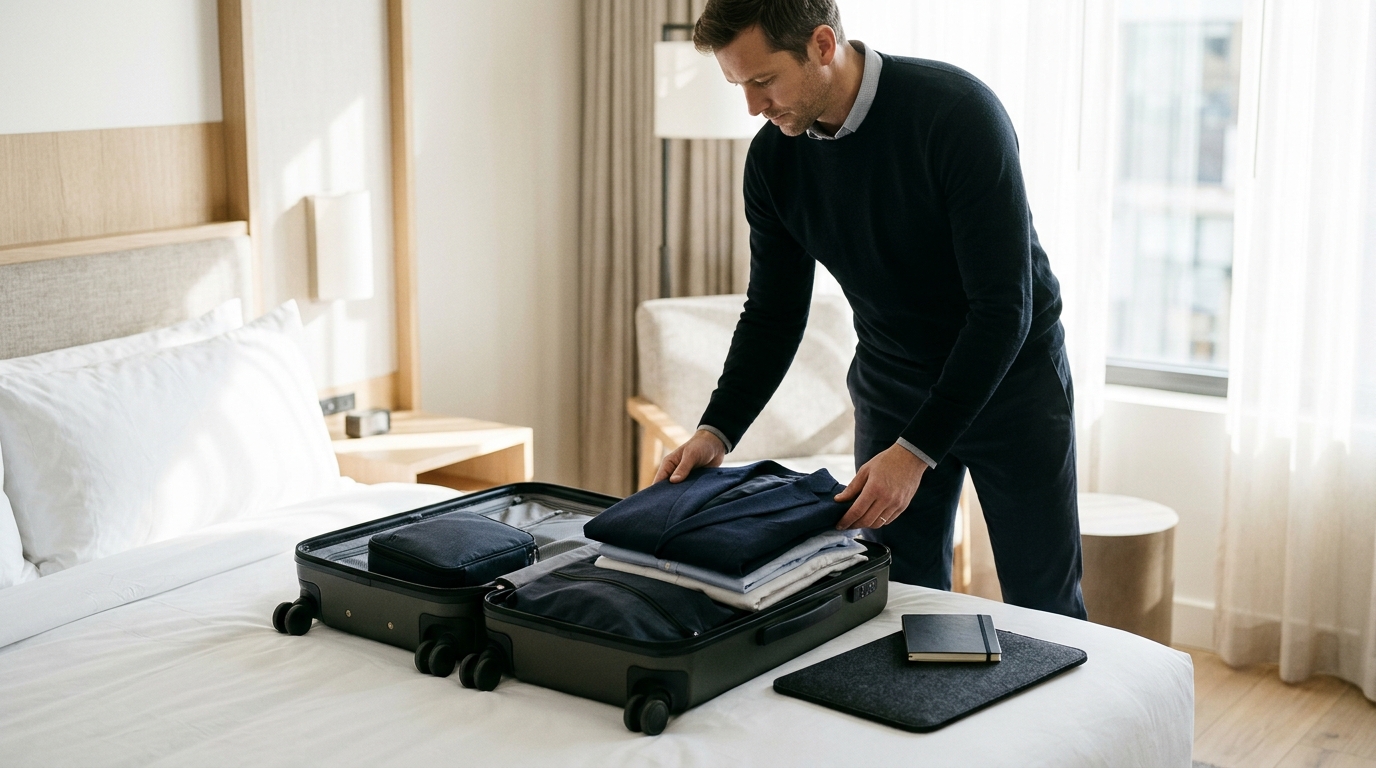
A vacation bag can absorb a few mistakes. If a T-shirt is wrinkled, nobody notices. A business trip is different: you land, and within a couple of hours you may be shaking hands in the clothes you packed. A good business trip packing list therefore has to protect your tailored clothes first and fit everything else around them.
Vacation lists also tend to grow with the length of the trip, while a work trip has fixed points: a meeting, a presentation, a dinner with a client. Each of those needs one specific outfit, a working laptop, and the right documents. If you plan around those fixed points, the bag stays small enough to carry on, and the carry-on keeps you out of baggage claim, which is where a delayed bag can cost you your suit.
This article gives you a system with three parts: a kit that stays packed between trips, a method for folding and layering tailored clothes, and a short routine for before you leave and after you land.
Why business trips need a different packing system than vacations
Three differences shape everything that follows.
First, the clothes are structured. A suit jacket has shoulder padding and a collar that hold a shape, and a dress shirt creases sharply at every fold. Casual fabrics forgive being squashed, and tailored ones do not.
Second, the schedule is tight. You rarely have spare time at the destination to find an iron, wait for the hotel to deliver one, or visit a dry cleaner. Whatever you pack has to be wearable when you unpack it.
Third, you will probably repeat the trip. Frequent flyers do the same packing many times a year, so a system you can run from memory beats a fresh list written each time. Repetition is also what lets you spot what you never use and drop it.
The core kit you leave packed between trips
The core kit is everything that does not depend on the destination or the number of days. Keep it in the carry-on itself, or in a pouch beside it, and never unpack it fully. When a trip comes up, you add clothes and a few extras, and the rest is already done.
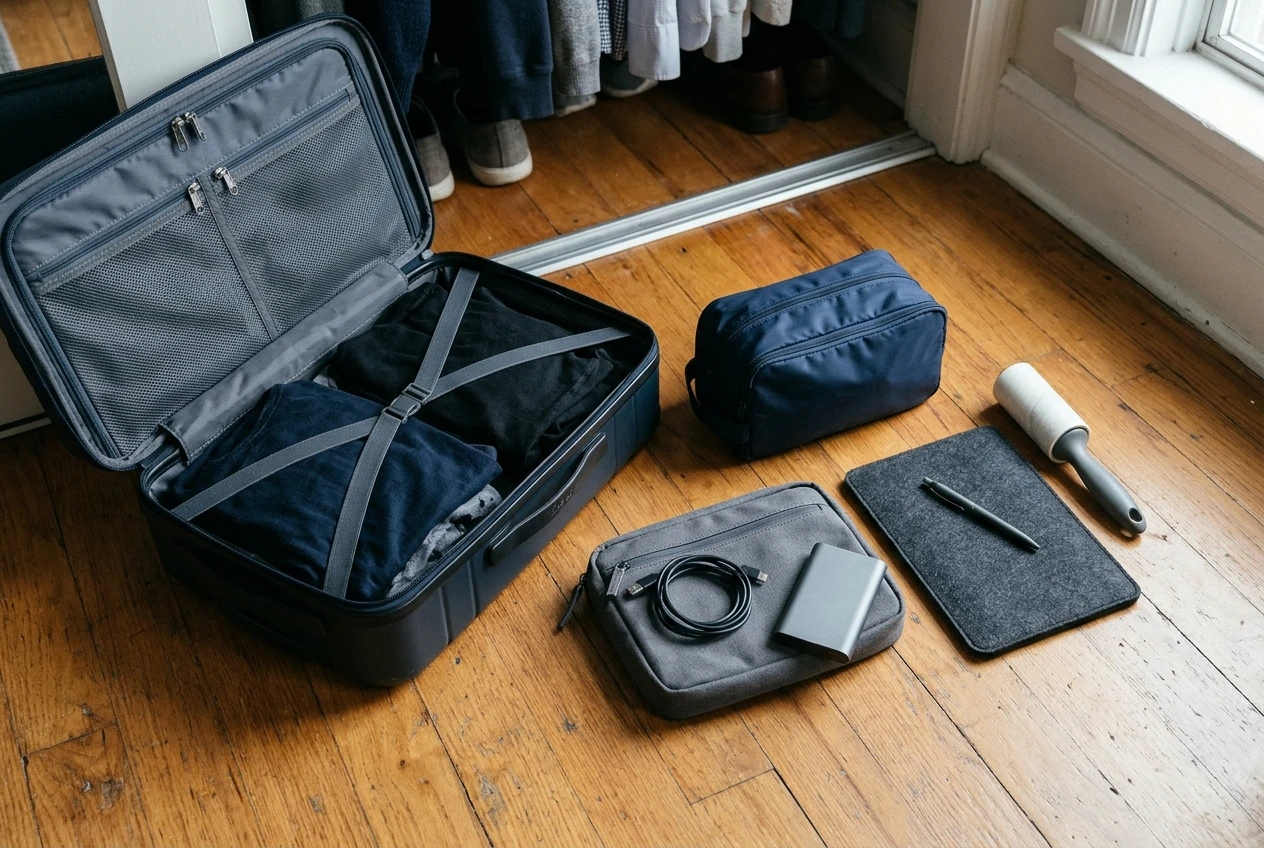
A reasonable core kit includes:
- A toiletry bag with travel-size versions of what you use daily, refilled right after each trip, and sized to the liquids rules at the airports you use
- A tech pouch holding a laptop charger, phone charger, a spare cable, and a small power bank
- A universal plug adapter if you cross borders, kept in the pouch
- A document sleeve with a pen, a few business cards, and a copy of your itinerary
- A lint roller or a few sheets of one, since dark suits show everything
- A small stain pen or wipes for the first spill before a meeting
- A spare pair of dress socks and a spare undershirt
- A compact collapsible umbrella
The rule is that anything in the kit gets restocked the day you return. If you finish a trip and put the bag in the closet with the empty toiletry bottles and a missing cable, the next trip starts with a scramble, which is exactly what a repeatable system is meant to prevent.
Keep the core kit small. Every item should be something you would be unhappy to be without on the road. If you reach the end of three trips and an item never left its pouch, take it out.
Building a work wardrobe that survives the overhead bin
Fabric choice does more for wrinkle resistance than any folding technique. Before you work out how to fold, decide what to fold.
For suits and trousers, wool and wool blends recover well from creasing because the fibers spring back, and they tend to relax when hung. Linen and 100 percent cotton crease easily and are hard to rescue without heat. Tightly woven fabrics usually wrinkle less than loose ones. A fabric labeled as wrinkle-resistant is worth testing at home by crumpling it in your fist for ten seconds and seeing what it does.
For shirts, non-iron or wrinkle-resistant cotton and performance blends survive packing far better than untreated cotton. Check how a shirt looks after it has been folded in a drawer overnight, since that is a fair preview of a day in a bag.
Build the wardrobe around one color family. If your suit is navy, choose shirts, ties, a belt, and shoes that all work with navy, and pack a second pair of trousers that matches the jacket or stands apart on purpose. Every item should work with at least two others. That is how a week fits into a carry-on without twelve separate outfits.
Wear the bulkiest items on the plane. A blazer, your heaviest shoes, and the thickest layer take up the most room, and wearing them frees space in the bag. A jacket you wear through the airport also never goes through the folding step at all.
Folding and layering a suit, shirts, and trousers to avoid creases
Creases form where fabric bends sharply and is held under pressure. The aim is to make gentle, wide folds, and to put padding at every fold so the cloth never has a hard edge to set against.
A simple carry-on packing order
Pack in layers to protect tailored clothes and keep essentials easy to find.
- Start with shoes. Place them near the wheel end or bottom edge, inside shoe bags or shower caps.
- Add the trousers. Fold along the crease and use them to wrap around the soft clothing stack.
- Place folded shirts near the top. Keep weight off the shirt stack so it does not get crushed.
- Lay the folded jacket on top. Avoid packing heavy items over it.
- Separate toiletries. Seal liquids and keep the toiletry bag where a leak will not reach a shirt.
- Keep work essentials accessible. Store the laptop in its sleeve and keep tech and documents in their usual pockets.
The suit jacket
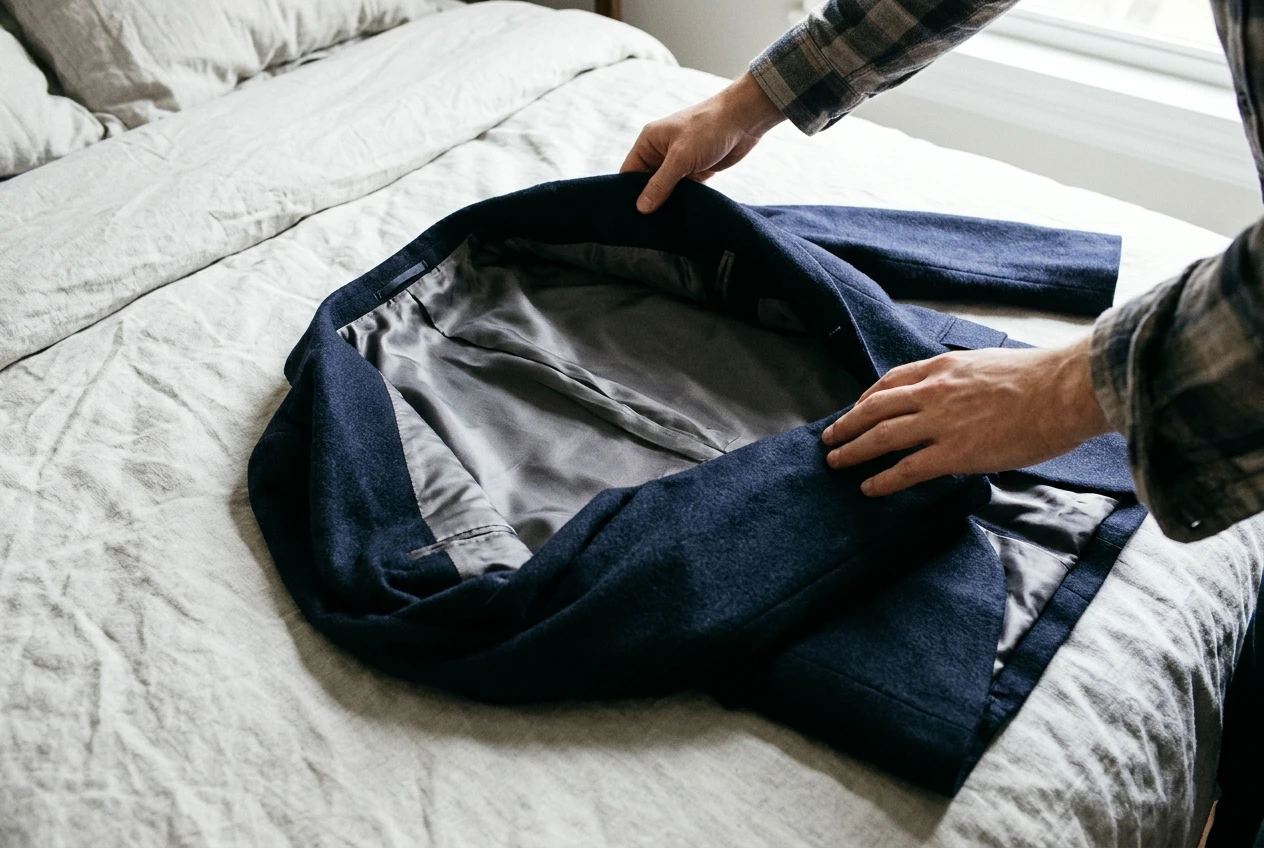
Turn the jacket inside out by pulling one shoulder inward so that the lining faces out, then fold the other shoulder over it so the shoulders nest together. The structured shoulders sit inside each other and keep their shape, and the outside fabric ends up protected by the lining. Fold once at the middle of the back, and lay it on top of the packed bag, not at the bottom.
If you carry a garment bag, hang the suit with the jacket buttoned at the top button and the trousers folded over a hanger bar. Fold the whole bag in half and keep it as flat as the carry-on allows. A garment bag works best when it is the only large item, because a suitcase stuffed on top of it will squash the folds.
Trousers
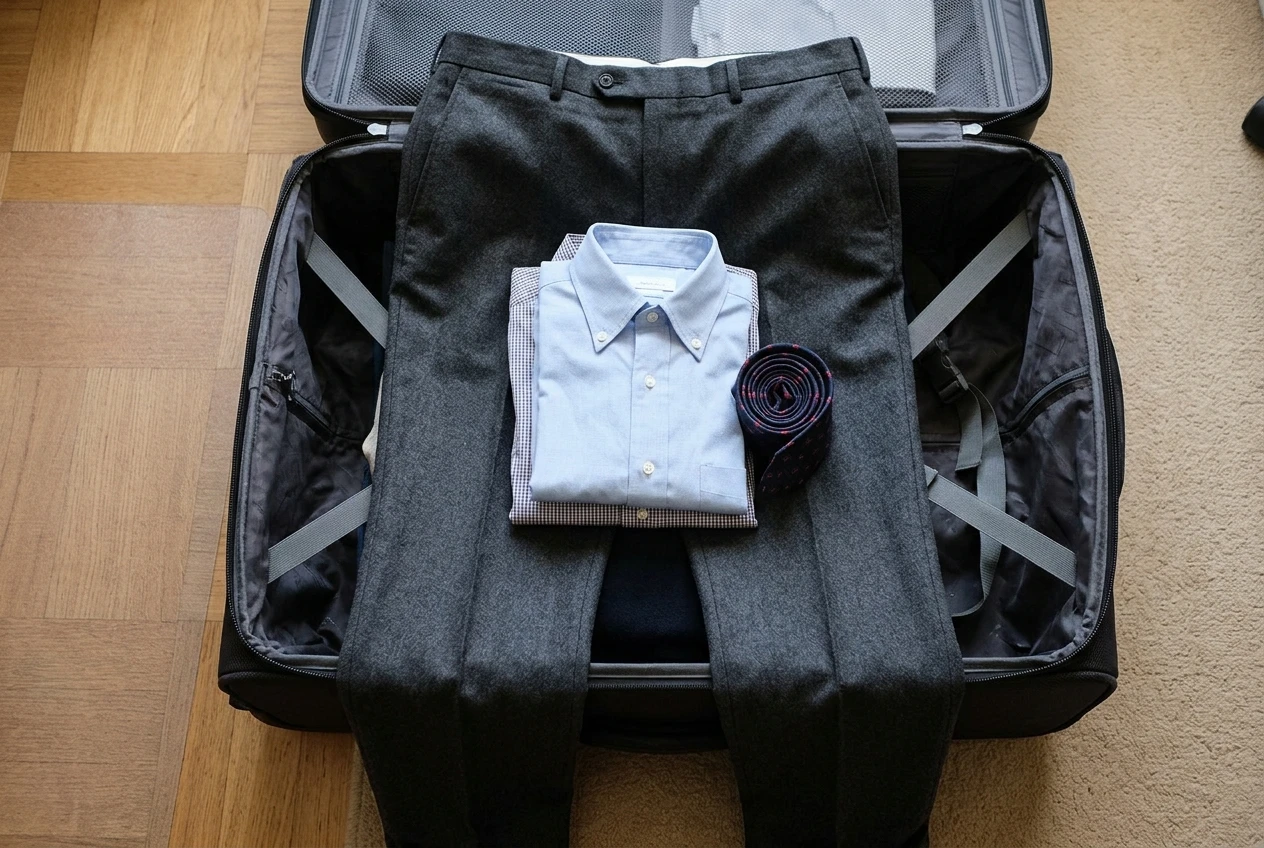
Fold trousers lengthwise along the existing crease, then lay them across the bottom of the bag with the legs hanging out over the edge. Pack other items on top, then fold the hanging legs over the stack. The trousers form a wrapping layer around everything else, and the fold sits across a soft cushion of clothing and not a hard edge. This is often called a bundle method, and it spreads the bend over a wide curve.
Dress shirts
Button the shirt, lay it flat, and fold the sleeves back behind it. Fold the body in thirds from the bottom up, keeping the collar clear. Some travelers slip a sheet of tissue paper or a dry cleaner’s plastic bag between layers so the fabric slides instead of gripping. Place the folded shirts in a packing cube or a flat folder so they cannot shift.
Put the shirt stack near the top of the bag, and keep the weight of other items off it.
Ties and belts
Roll a tie loosely and tuck it into a shoe or a small pouch. Coil a belt around the inside edge of the bag.
Organizing tech, chargers, and documents so security and meetings go smoothly
Anything you must pull out at security should live in the same place every time. Put the laptop in a sleeve in the outer compartment, where it comes out without disturbing the clothes. The tech pouch goes right beside it, and the document sleeve stays in the front pocket or in a personal item.
Keep your passport or ID, boarding pass, and phone in one pocket of your travel clothes or a small organizer so you never dig through the bag. If you will present documents at the destination, such as an invitation letter or a printed agenda, keep them in the sleeve and flat, away from the folded clothes.
For the meeting itself, pack what you present with. A clicker, a dongle for the projector input your host uses, and a copy of your slides on a drive or in cloud storage each cost almost nothing to carry. Download offline copies of the files before you leave, as hotel and airport Wi-Fi can fail at the worst moment.
Label cables or use colored ties so you can tell the laptop charger from the phone charger at a glance. A mix-up in a dark hotel room is easy, and it is a small enough fix to prevent.
Packing shoes and toiletries without damaging your clothes
Shoes are the heaviest, dirtiest items in the bag, and they belong along the wheel end or the bottom edge of the carry-on, so the weight sits low and does not press on folded shirts. Put each pair in a shoe bag or a shower cap, and stuff the inside with socks, a belt, or chargers so the shape holds and no space is wasted. The fuller treatment of this is in How to Pack Shoes Without Ruining Your Clothes, which covers sole-to-sole placement and bag choices in more detail.
Limit yourself to one pair of dress shoes plus the pair you wear on the plane. If both need to be formal, pick a pair of black or brown leather shoes that match the suits in your rotation.
Toiletries leak when cabin pressure changes, so use a sealed bag and place it where a leak will not reach a shirt. Keep it near the top of the bag, in the side pocket if one exists, and place it on a layer of something you can wash, such as a pair of socks. Choose solid versions where you can, since a bar of soap or a solid deodorant cannot spill. Decant liquids into small bottles that are only about three-quarters full, which leaves room for the air to expand.
The 10-minute routine before you leave and after you land
A short routine prevents most packing mistakes, because it catches them while there is still time to fix them.
Before you leave
- Check the forecast and the schedule, and list each meeting or event with the outfit assigned to it.
- Lay out the clothes and confirm that each piece is clean, undamaged, and free of loose threads or missing buttons.
- Pack the bottom layer first: shoes, then the trouser bundle, then shirts, then the folded jacket on top.
- Add the core kit, then check the document sleeve for passport, boarding pass, and printouts.
- Charge the phone, laptop, and power bank.
- Weigh or lift the bag and check it against your airline’s carry-on size and weight limits, since those vary by carrier.
After you land
- Unpack the suit and shirts first, before checking email or settling in.
- Hang the jacket and trousers on proper hangers, not the thin ones from the closet if they are poor, and let them hang for a few hours. Most mild creases relax in that time, especially in wool.
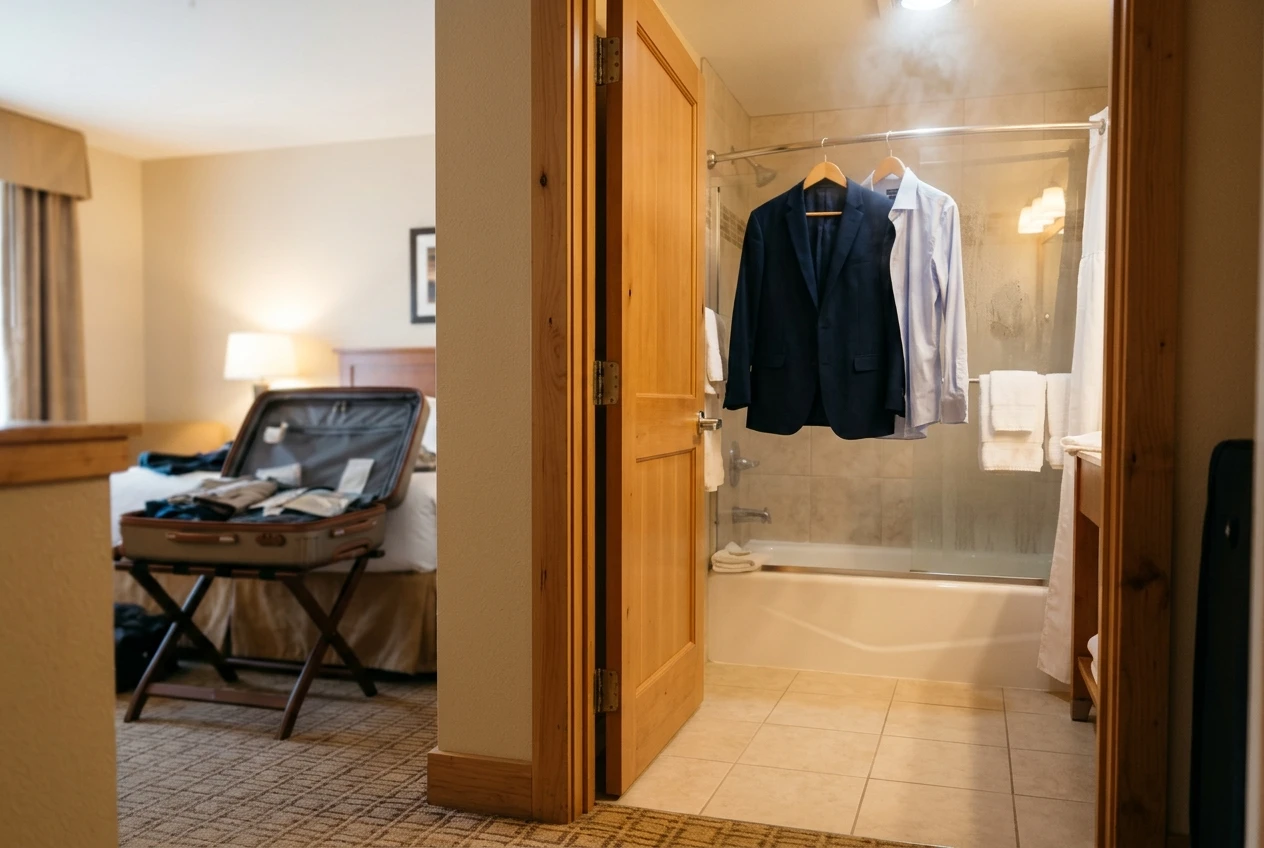
- Hang shirts on the shower rod or a door while you shower, since the humidity in the room helps loosen light creases without any equipment.
- Put the tech pouch and documents where you will find them in the morning.
- Set out the outfit for the next day and check it in good light.
On the way home, the same routine runs in reverse: gather the worn clothes into one bag, restock the core kit on return, and put the carry-on back where it lives.
Adjusting the list for one-night trips versus a week on the road
The core kit stays identical on every trip. What changes is the clothing, and a few extras.
Match the clothing plan to the trip
Keep the core kit packed between trips. Adjust the clothes and extras for the number of days away.
One night
Wear the suit on the plane. Pack a fresh shirt, underwear, socks, toiletries, tech, and documents.
Two to four days
Pack one suit, a second pair of trousers, and one more shirt than the number of meeting days.
A week or more
Pack mix-and-match jackets, trousers, and shirts. Plan to use hotel laundry or wash some items in the sink.
One night
Wear the suit on the plane and skip the folding entirely. Pack a fresh shirt, underwear, socks, and the toiletry bag, plus the tech pouch and documents. This usually fits in a bag small enough to go under the seat, which means you never touch the overhead bin and can leave quickly.
Two to four days
Take one suit with a second pair of trousers, and rotate shirts with one more than the number of meeting days. The jacket can repeat across days if you air it out between wears. This is where a trouser bundle and a flat shirt stack earn their place.
A week or more
Do not pack seven outfits. Pack two jackets that mix with different trousers, shirts for about half the days, and use the hotel laundry or a wash in the sink for the rest. Quick-drying underwear and socks make that possible. If the trip crosses several cities, rewrite the plan by city, so each stop has its own outfit and the bag does not carry more than it needs.
For a week-long trip the bag will be near its limit, so weigh it at home and place the heavy items low. Add a small laundry bag so worn clothes stay apart from clean ones.
After landing: protect tomorrow’s outfit
Unpack the clothes before settling in. A few quick steps can help you avoid a morning scramble.
- Hang the jacket and trousers on proper hangers and let them air for a few hours.
- Hang shirts on the shower rod or a door while you shower to help loosen light creases.
- Put tech and documents where you can find them easily in the morning.
- Set out the next day’s outfit and check it in good light.
Build your own reusable kit
Start with the core kit, restock it after every trip, and add the clothing plan that fits the trip length. Head to the packing checklist finder to grab the checklist that matches your next trip type and build your own reusable business kit from it.